

Class Rules
As classes start up again this fall, it\’s a good time to look at classroom rules and the impact they have on student learning. Every “rule” should be necessary to move us toward our end goal and provide each student with a fun, supportive, healthy learning environment. Fortunately, for most adult ESL classes rules don’t need to focus on behavior like in a K12 environment. In addition to the obvious “Respect Others” that is especially important when interacting cross-culturally, I’ve found these 3 rules to be indispensable for a successful ESL class. English Only If your students don’t practice speaking English in
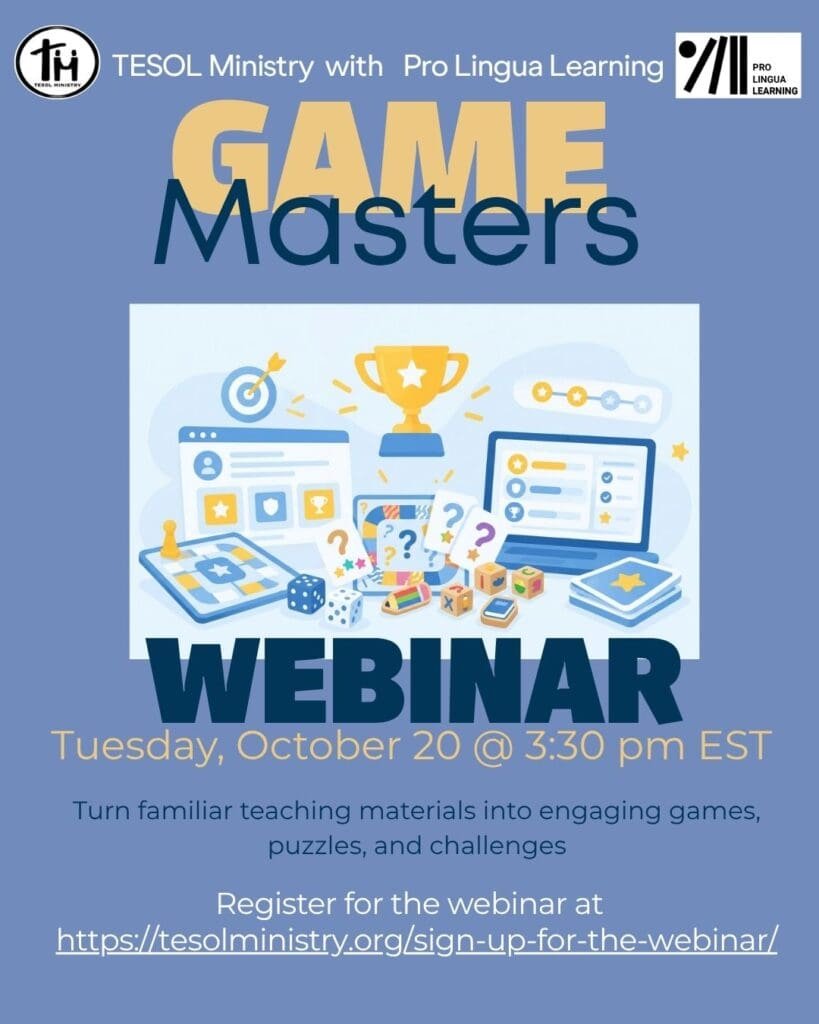
Game Masters: Level Up Your Teaching Skills
Presented by: Katie Callahan Neginskiy, President Pro Lingua Learning What if you could turn the textbooks and print materials you already use…
Read More →
Using AI to Enhance Traditional ESL Materials: A Dummies’ Guide
Presenter: Katie Callahan Neginskiy. In this webinar offered in collaboration with Pro Lingua Learning, you'll gain easy-to-use approaches to enhance your traditional…
Read More →
Mission Possible: Fun Grammar and Vocabulary Practice
Presenter: Elisabeth Bowman, The Gaming Grammarian, presents in this webinar for volunteer ESL teachers. She shares practical, classroom-ready ideas to repurpose your…
Read More →
Literacy Foundations for Adult ESL Webinar
Shelley Hale Lee, an ESL teacher trainer specializing in literacy approaches for ESL emergent readers, discussed teaching literacy to pre-literate adult ESL…
Read More →

Learn My Language, Touch My Heart
When people find out that I teach ESL (English as a Second Language), they often ask me the same question: “How can you teach international students if you don’t know all those languages?” Actually, you don’t have to be able to speak the languages of your students to teach them English. They’re in the class to learn English, and if you constantly speak their language, it defeats the purpose. Having said that, you do have an advantage if you understand the basics of your students’ language. You can predict some of the grammar and pronunciation challenges they will face, and

Key 1:Cultural Understanding
This 3 part series is an excerpt from the the Institute of Cross Cultural Training’s “Reach Out With English” training and has been shared with ICCT’s permission. Three Important-and Often Neglected Keys to an Effective ESL Ministry Key 1: Cultural Understanding In making your decision to become an ESL teacher, you have probably prayed about your desire to minister to those who have a range of needs that go beyond the learning of the English language. As a Christian, no doubt you want to demonstrate the love of Jesus to a group of people who find American customs and values
Key 2: Quality Teaching
This 3 part series is an excerpt from the the Institute of Cross Cultural Training’s “Reach Out With English” training * and has been shared with ICCT’s permission. Three Important-and Often Neglected Keys to an Effective ESL Ministry Key 2: Quality Teaching When the need for ESL teachers in our communities is so great and there is pressure to begin teaching as soon as possible, it’s easy to be tempted to simply jump in and do your best while learning on the job. There are times that approach is necessary, but you need to realize that there may be a
Key 3: Focus on Learner Needs
This 3 part series is an excerpt from the the Institute of Cross Cultural Training’s “Reach Out With English” training and has been shared with ICCT’s permission. Three Important-and Often Neglected Keys to an Effective ESL Ministry Key 3: Learner Needs When planning a Sunday School curriculum, we often begin by focusing on people’s spiritual needs and then we think about how we can address those needs through our instruction. Following this familiar model, your natural inclination may be to consider the spiritual needs of your ESL learners and then look for teaching materials that highlight a range of basic
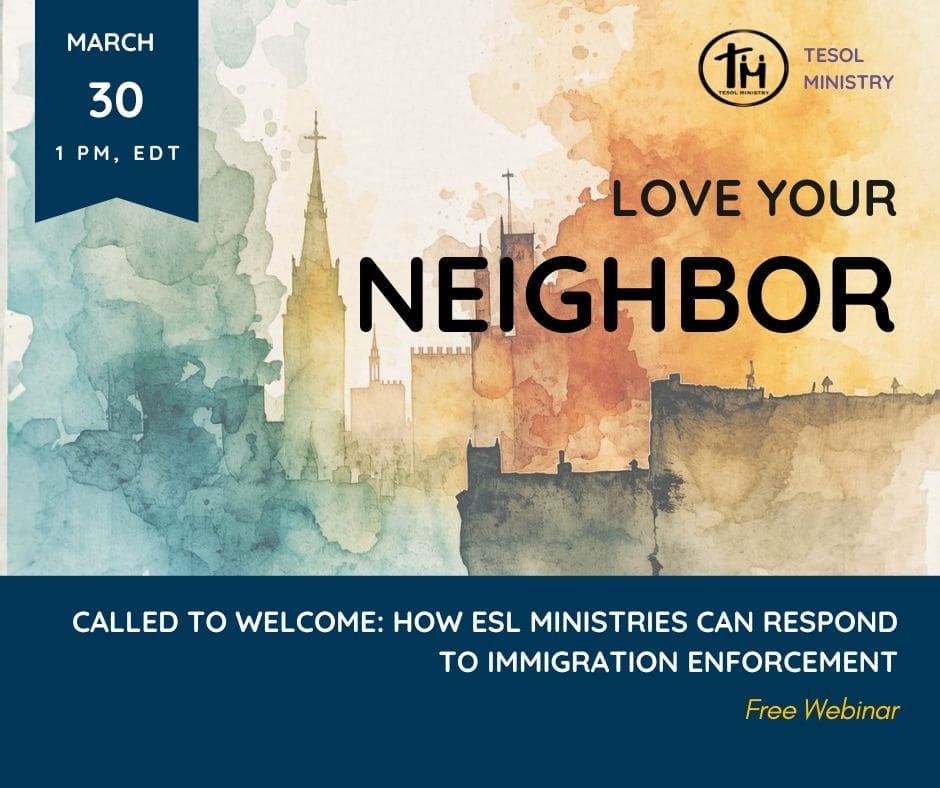
Called to Welcome: How ESL Ministries Can Respond to Immigration Enforcement
As immigration enforcement intensifies, ESL ministries are on the front lines — fielding fear, fielding questions, and wondering what faithful presence looks…
Read More →
Called to Welcome: How ESL Ministries Can Respond to Immigration Enforcement
As immigration enforcement intensifies, ESL ministries are on the front lines — fielding fear, fielding questions, and wondering what faithful presence looks…
Read More →
Curriculum Panel Webinar
Panelists Dianne Dow, Billy Haselton, and Marilyn Reedy are joined by moderator, Alisha Biler, current CELEA president in this fantastic panel discussion…
Read More →

Communicating the Gospel Cross Culturally – part 2
How is the Gospel Best Presented? If our Christ-given task is to make disciples, we also need to examine how we present the gospel. Do most of the long-lasting decisions that lead to people becoming committed followers of Jesus come from five-to-15-minute concept-centered presentations of the gospel, or do they come from some other longer, relationship-based sharing of the gospel? Oscar Thompson, author of Concentric Circles, and Jim Petersen, author of Evangelism as a Lifestyle make convincing arguments for relationship-based, or friendship-based evangelism. Our own experience also led us to the same conclusion. Near the beginning of our ministry in university student evangelism and disciplemaking in Mexico, we
Communicating the Gospel Cross Culturally – part 3
What Aspects of a Person’s “Being” Do We Need to Consider as We Share the Gospel? There are three aspects of every person’s being which need to be active in “believing” or “having faith” in Jesus, regardless of cultural background. One of those aspects is the intellect. The fact that I mention this first does not mean this is the first thing you need to focus on in transcultural witnessing. In most cases the first aspect that comes into play in the life of an individual who is investigating faith in Jesus are the emotions, which will be the next aspect I mention. But
Communicating the Gospel Cross Culturally – part 4
How Culture Shapes our Presentation of the Gospel How does culture tend to shape our presentation of the gospel? I have already touched on this some: we are much more direct in our communication style than many other cultures in the world, and we tend to think that this is much better . . . because we are used to being direct. But many cultures in the world, including Asian and Latin American cultures, are more indirect in their communication style. Our style is not necessarily better than theirs. Probably one of the most difficult things for us to understand about

Reaching the Nations . . . from Your Front Porch
Internationals: Who Are They? How far are the nations from your front porch? They’re closer than you think. The nations are all around us. To reach them, we must understand who they are. Just like us, internationals are not all the same. Here are just a few of the types of internationals among us: How Can We Connect with the Nations in Our Midst? Getting involved with the internationals around us is quite simple, but it requires intentional effort. If you’re not sure where to begin, here are a few ideas: 1. Start up a conversation with the clerk at a
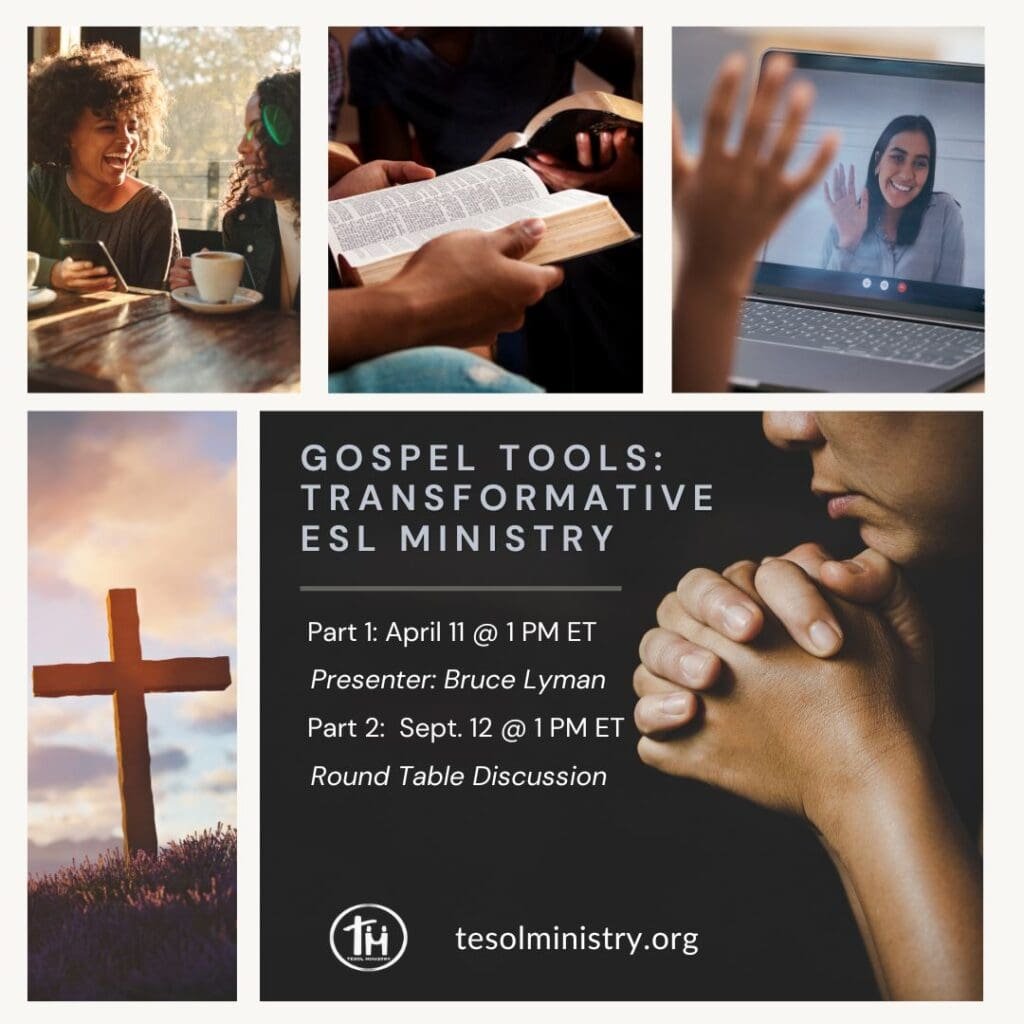
Gospel Tools: Transformative ESL Ministry, Part 1
Can your English ministry be more effective? Learn practical tools for sharing your faith respectfully and effectively in this 2 part series.…
Read More →